
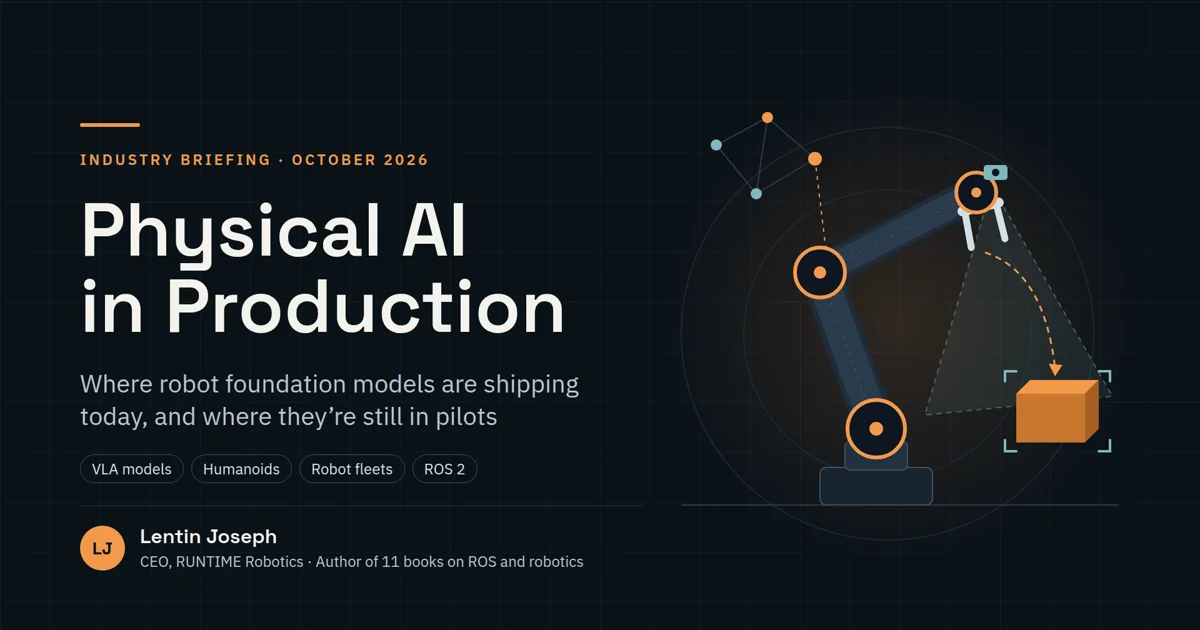
Physical AI means AI models that perceive and act in the physical world: robot arms, humanoids, warehouse fleets and robotaxis. Every week brings a new demo, but demos aren’t deployments. We built Physical AI in Production, an open industry briefing, to separate what is genuinely running in production from what is still in pilots, and to give engineers a practical path to ship a robot foundation model safely.
View the slides → · Source on GitHub →
What’s inside
- LLM vs. VLM vs. VLA. One prompt answered three ways, plus how a Vision-Language-Action model is built.
- Ten open-weight VLA models you can download today, from OpenVLA to LingBot-VLA 2.0, with size, release date and license checked against their model cards.
- Real deployments with evidence. Amazon’s 1M+ robots and DeepFleet, Agility Digit at GXO, Figure at BMW, and Waymo’s 500k+ weekly paid rides.
- The global picture. China’s lead in humanoid volume, and the Physical AI companies and policy emerging in India.
- Why it’s harder than chatbots, and the two business models forming around robot intelligence.
An eight-stage production playbook
The second half of the deck is for the engineers who have to make it work:
- Specify the job, then build the data
- Choose the model: build, fine-tune or call an API
- Climb the evaluation ladder
- Bound the model with a layered safety architecture
- Fit the model inside the on-robot control loop
- Integrate it with a ROS 2 reference architecture
- Roll out in stages and run the data flywheel
- Pass a production-readiness checklist
The core message: bound the model, don’t trust it. A VLA can propose actions, but certified safety layers, controllers and staged rollouts decide what actually reaches the motors.
Who it’s for
The briefing is written for robotics engineers, technical leaders and decision-makers alike. It stays technical where it matters: model architectures, evaluation, safety, on-robot inference and ROS 2 integration.
Open the deck in any browser and use the arrow keys to move through the slides. You can link to any slide by adding #n to the URL. If you’re planning a Physical AI deployment and want help taking it from pilot to production, get in touch with RUNTIME Robotics.