
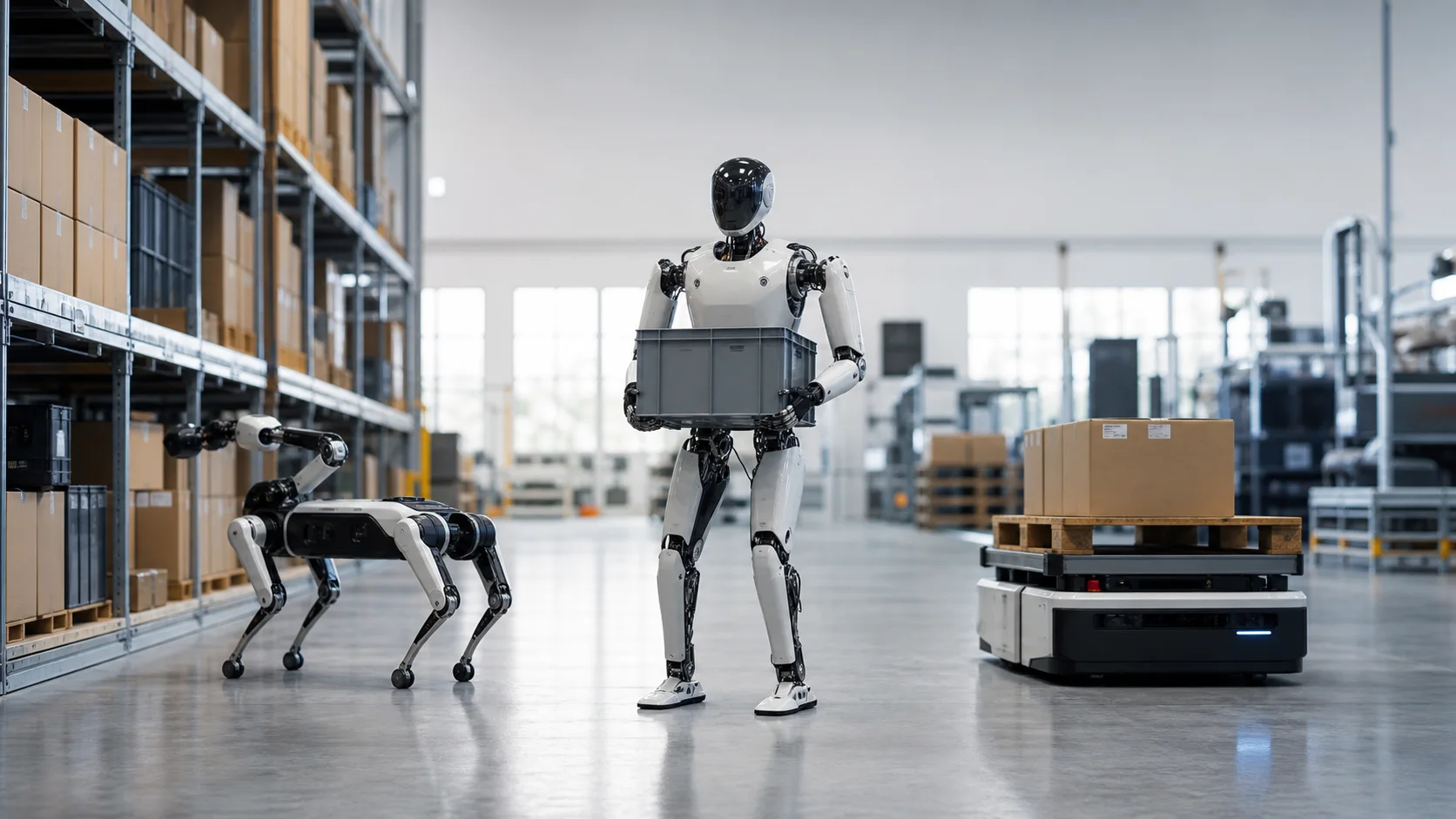
Robotics software is moving beyond isolated algorithms. The next generation of robots will combine perception, reasoning, simulation, learning and dependable real-world control into one continuous engineering workflow. This is Physical AI: AI that understands its environment, makes decisions and acts through a physical machine.
ROS 2 remains the integration layer for this future. It connects sensors, navigation, manipulation, fleet systems and hardware drivers into modular applications. NVIDIA Isaac ROS builds on ROS 2 with GPU-accelerated packages and AI models, helping teams accelerate perception, navigation and manipulation workloads on NVIDIA hardware.
From robot code to robot intelligence
Traditional robot projects often begin with individual components: a camera driver, a navigation stack, a manipulator controller and a user interface. Physical AI connects these components with AI models that can interpret images, language and robot state together.
Consider a warehouse instruction: “Pick the damaged box from aisle four.” The robot must identify the correct shelf, navigate safely, understand which object is damaged, plan a grasp and verify the result. This is not one model or one ROS node—it is a complete software system.
Simulation becomes part of the development process
High-quality simulation is no longer only for demonstrations. A digital twin lets teams test navigation, perception, manipulation and failure cases before deployment. With NVIDIA Isaac Sim and Omniverse technologies, developers can assemble USD-based scenes, simulate physics and sensors, generate synthetic data, and connect ROS 2 stacks for software-in-the-loop validation.
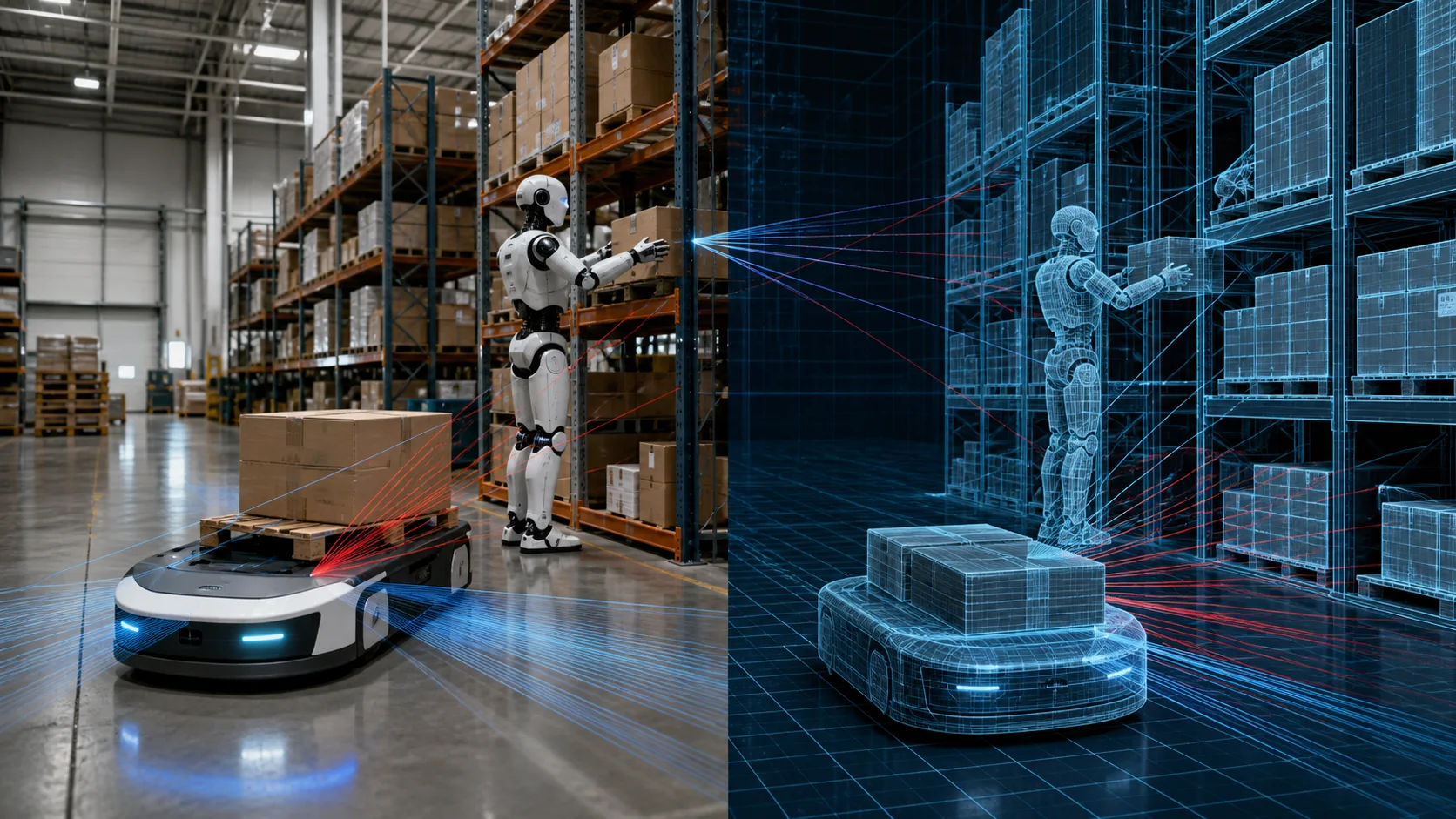
The practical result is faster iteration: test a navigation change in many warehouse variations, validate a camera pipeline under difficult lighting, or train a policy before placing a robot near people or expensive equipment.
Robot learning: RL, imitation learning and VLA
Reinforcement learning helps robots learn control policies through repeated interaction in simulation. Imitation learning uses demonstrations, including teleoperation data, to teach skills such as grasping, walking and tool use.
Vision-Language-Action (VLA) models extend this idea further. They combine visual input, language instructions and robot actions, helping robots execute tasks with more flexibility than fixed, hand-authored workflows. For humanoid systems, foundation-model approaches such as NVIDIA Isaac GR00T bring perception, language reasoning and action generation together for manipulation tasks.
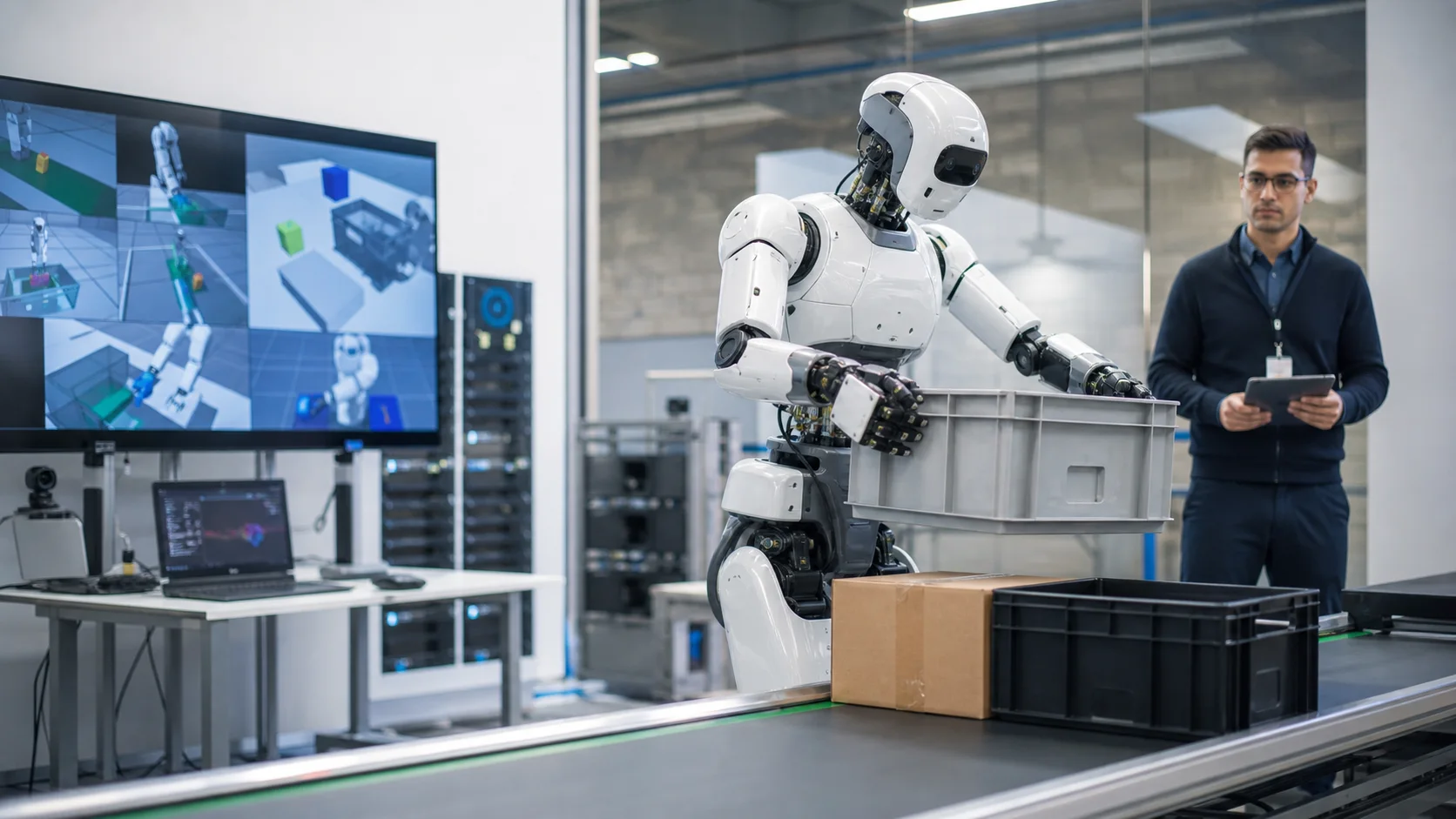
Watch: NVIDIA Isaac GR00T N1
The software stack for modern robots
A practical Physical AI stack can be viewed in five layers:
- Hardware — cameras, LiDAR, joint controllers, compute and safety systems.
- ROS 2 — drivers, transforms, communications, lifecycle management and application integration.
- AI perception — accelerated vision, depth, segmentation, pose estimation and multimodal models.
- Simulation and learning — Omniverse, Isaac Sim, synthetic data, reinforcement learning and imitation learning.
- Deployment and operations — validation, monitoring, updates, fleet coordination and measured real-world performance.
The important point is that these layers must be engineered together. A policy that works in simulation still needs reliable sensor calibration, safe motion constraints, ROS 2 integration and measured performance on the deployed robot.
What this means for robotics teams
The future belongs to teams that can move confidently between simulation and hardware. They will build reusable ROS 2 interfaces, create realistic digital twins, use GPU acceleration where it matters, and validate AI behavior with clear safety boundaries.
At RUNTIME Robotics, we see this as an opportunity to build better autonomous mobile robots, quadrupeds, humanoids and industrial automation systems—using ROS, NVIDIA Isaac, Omniverse and Physical AI workflows as one connected platform.